The Largest Online Community for Contact Centre Professionals


The Largest Online Community for Contact Centre Professionals
 Close
Close


Published On: 10th Dec 2025 15:00 - Modified: 22nd Jun 2026
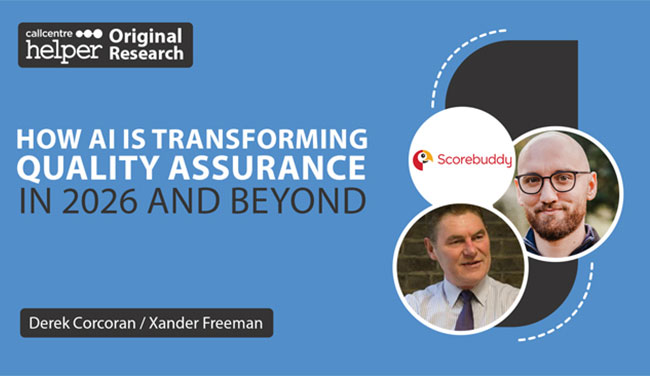
As part of the latest Call Centre Helper research, we took a deep dive into the evolving role of Quality Assurance (QA) and how teams are adapting to rapid change.
This section of the research was sponsored by Scorebuddy, and we had the opportunity to explore the findings in more depth with their CEO, Derek Corcoran, whose perspective helped bring the data to life.
One theme came through loud and clear: QA is no longer a static, back-office function. Instead, it’s in the middle of a transformational AI-driven shift.
Unsurprisingly, AI sits front and centre of the QA conversation. However, balancing the benefits with the logistics of putting it in place can be tricky for some organizations to get their arms around.
It’s no secret that AI represents a significant opportunity, yet many are grappling with how to implement it. Budgets are tight, expectations are high, and the fear of getting it wrong is very real.
Despite this uncertainty, we believe that, if you’re playing your cards right, QA provides one of the clearest examples of where AI can deliver tangible value for both the business and the agents today.
A function that was once seen as relatively static has been given a huge injection of momentum through the deliberate implementation of AI – just look at what has already been done with auto QA, and where we can take it next.
As AI-powered QA solutions are rolled out, organizations are learning in real time. New use cases emerge, challenges surface, and approaches need to be tweaked as we go. The ability to configure AI to fit specific QA needs is phenomenal, but this configurability doesn’t come without risk.
A poorly designed or badly calibrated AI evaluator can do more harm than good. Bias, mis-scoring and agent mistrust can all creep in if guardrails aren’t in place.
The message from the research is clear: AI in QA works best when it’s treated as an evolving partnership, rather than a “set and forget” solution.
When respondents were asked what they would most like to change about their QA programmes, coverage emerged as the clear winner. Traditional QA teams have long struggled to review enough interactions to remove bias, spot trends and capture edge cases.
Auto QA suddenly makes all that (and more) possible.
During our conversation, Derek highlighted a standout use case that saw a generative AI bot conversation stream that evaluated 50,000 interactions per month. That’s the equivalent of 34 human evaluators.
Of course, economically speaking, that doesn’t mean you can suddenly demand the cost of 34 evaluators to funnel into AI. Implementing AI in this scenario doesn’t necessarily release cash.
What it can do, however, is deliver dramatically increased visibility at very little additional cost. It frees up existing QA resources to focus on higher-value work: analytics, analysis and targeted coaching.
Just as importantly, it creates vital brain space within teams that can too often be overlooked, but can be absolutely groundbreaking.
To secure buy-in from senior leaders, these benefits need to be translated into hard numbers. Put it into pounds or dollars, and watch mindsets start to shift.
Another challenge highlighted by the research is making people aware of QA and its benefits. QA often sits quietly within operations and can potentially be overlooked by wider leadership teams.
Yet the promise of modern QA technology is huge – not just in efficiency, but in the volume and richness of data it can generate when used correctly.
“The trick is for the operational teams and CX leaders to understand the value of it and to be able to tell that story and narrative to the C-suite so that they are now invested. That will power the change.”
QA data has the power to drive strategic change across the business, but only if its value is clearly articulated and shared.
Looking at our survey, scorecards remain the most common application of AI in QA, but speech and sentiment analysis came a close second, highlighting how far these tools have matured.
This puts contact centres in a powerful position. While every department is looking to weave AI into their operations, contact centres are where the data lives, and QA teams are sitting on some of the richest insights in the organization.
Derek told us about one example from last Black Friday that illustrates this perfectly. A sudden spike in contacts appeared with no obvious cause. Using conversation analytics in semi-real time, the team identified that a specific delivery partner was missing SLAs, driving the surge.
The issue, that might otherwise have been invisible to the CX team, was resolved quickly, avoiding prolonged customer dissatisfaction and driving down the contacts.
That’s QA shifting from reactive to proactive – and delivering value far beyond the contact centre.
Of course, none of this comes without challenges. Advanced analytics exposes skill gaps that haven’t always been front of mind for QA and CX teams. Business analytics, BI management and dashboard design now matter more than ever.
There’s also a growing need to understand how to interact with AI effectively and extract the maximum value without being influenced by potential biases and inaccuracies that could creep into a badly designed scorecard matrix
This is where the human truly comes back into the loop.
The most effective QA strategies, Derek explained, rest on three pillars:
Put simply, what we’re seeing is automation at the front end, particularly around analytics and scoring, alongside augmentation, where agentic AI is embedded into products as a coach or advisor so manual tasks (like reviewing large volumes of data) can be completed at the flick of a button.
Crucially, this still serves the human performer, with AI acting as an assistant rather than a replacement, while the human-in-the-loop approach remains central to how these capabilities are designed and implemented, ensuring people are actively involved in oversight, judgement and decision-making throughout the process.
Coaching didn’t rank as highly as automation in current priorities, but the intention is there. Around 44% of respondents are either implementing or planning to implement AI-supported coaching, placing the industry at the very start of the adoption curve.
As auto QA frees up resources, those hours haven’t yet been fully reallocated. But the potential is clear. AI excels at analysing large datasets and summarizing patterns, which is the ideal foundation for personalized coaching plans built from hundreds of interactions, rather than a handful.
When it comes to measurable attributes in digital channels, compliance remains the top priority, particularly in heavily regulated industries such as healthcare, insurance and financial services.
AI is exceptionally effective at scanning large volumes of interactions to identify breaches and coach out risky behaviours before they escalate.
Empathy and speed of response also feature prominently, measuring if the agent has demonstrated understanding of the customer’s needs, documenting their response time, and even taking into account the pauses in between their back-and-forth.
In emotionally charged, compliance-heavy environments, getting this balance right benefits everyone. Agents can receive fairer coaching, customers have better experiences, and businesses operate within robust guardrails.
To find out what else was uncovered in the report, download it for free now: What Contact Centres Are Doing Right Now

Xander Freeman, Director, Call Centre Helper
Xander is a regular host and moderator of webinars, interviews, and live panels on a wide range of topics in the customer contact space – sharing insights on CX innovation, AI, workforce management, and more.
Connect with Xander on LinkedIn
Read more by Xander Freeman

The Latest Customer Contact Research, Reports and White Papers straight to your inbox!
Get the latest insights from Call Centre Helper by signing up for our email content.
Close


14th October 2026
18th October 2026


