
The Largest Online Community for Contact Centre Professionals


The Largest Online Community for Contact Centre Professionals
 Close
Close




Published On: 26th Jan 2026 08:00 - Modified: 8th Jul 2026
Mistakes happen. It’s just a fact of life. For some, these moments create fantastic learning opportunities.
Yet, for many, mistakes result in panic and the instinct to cover up their failure at all costs – which can have disastrous consequences.
That’s why we asked consultant James Lawther to put the spotlight on exactly how bad things can get when failures and setbacks are routinely covered up, and how to promote an open, honest culture instead.
On Sunday, the 1st of December 1974, Trans World Airlines (TWA) flight 514 flew towards Washington Dulles airport. As it came in to land, the air traffic controller said, “Cleared for approach”.
The flight crew thought it meant one thing (we will guide you in), but the control tower meant something different (guide yourself in).
It was a simple miscommunication. Minutes later, TWA flight 514 flew straight into the side of Mount Weather, 510 metres above sea level. Ninety-two people died. There wasn’t a single survivor, all because of a misunderstanding over a few words.
You will know about the “Accident Triangle” if you have ever worked in health and safety. It is a simple idea:
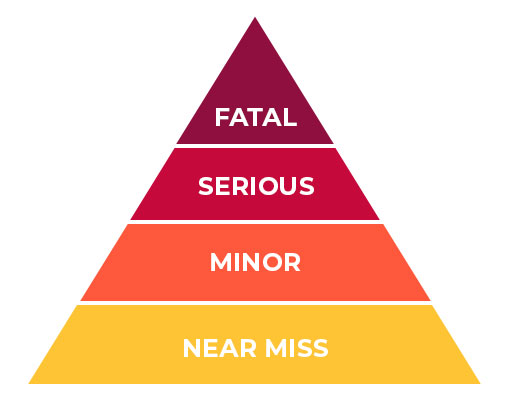
Near misses come in all shapes and sizes:
Near misses don’t kill anybody, but it isn’t too hard to imagine how circumstances combine to create disastrous outcomes. Quite simply, as the number of minor incidents rises, the likelihood of a fatal accident increases.
Consequently, health and safety professionals obsess about reducing near misses. Every time there is one, they insist it is reported and the cause removed. By removing minor issues, such as “trips and slips”, an organization can reduce the risk of a fatality.
Learn from the mistakes of others. You don’t have time to make them all yourself.
– Eleanor Roosevelt
The people responsible for US air safety in the 1970s, the Federal Aviation Administration (FAA), knew about the accident triangle.
They also knew exactly how to use it. They had mandated that aircrew report every near miss. It was the law, yet pilots routinely failed to highlight problems.
During the investigation into TWA flight 514, it became clear that this wasn’t the first time a flight crew had misunderstood air traffic control’s instructions.
Six weeks earlier, a United Airlines flight had narrowly missed the same fate, brushing the treetops on the same hillside for the same reason. Yet the United Airlines flight crew had kept quiet and ignored the law requiring them to report the incident.
It wasn’t that the pilots didn’t care about safety, just that they didn’t trust the FAA.
In addition to collecting data on near misses and accident reporting, the FAA was responsible for policing the aviation industry.
They could fine, imprison, and revoke the licences of pilots they caught doing wrong. This fact meant that a pilot had two options after a near miss.
They could either speak up and risk losing their livelihood or shut up and hope nobody else had the same misfortune. As the fear of being blamed for the incident outweighed the benefit of reporting it, many pilots and co-pilots chose the second option.
The National Aeronautics and Space Administration (NASA) came to the rescue and solved the problem. It took responsibility for collecting near-miss information and developed the Aviation Safety Reporting System (ASRS) that removed fear and blame.
Pilots report incidents to NASA, but NASA cannot punish them. NASA then analyses the data and produces reports for the FAA that show the high-risk areas.
At the same time, they strip all the incriminating details from the information they have, and the pilots remain anonymous.
As an additional incentive for pilots to report issues, it counts in their favour if the FAA ever investigates them and they can show they reported an incident. The FAA sees this action as evidence of a “constructive safety attitude”.
ASRS has a strapline that says it all: “Confidential, Voluntary, Non-Punitive”.
This approach is all very clever, but does the system work?
Lina Connell, the scheme’s director, celebrated its 40th anniversary in 2016, claiming that “Since the implementation of the Aviation Safety Reporting System, approximately 1.4 million reports have been submitted by pilots, dispatchers, mechanics, air traffic controllers, flight attendants, ground personnel, and others.”
Over the same period, ASRS issued over 6,200 safety alerts to the FAA about numerous issues, from air traffic departure procedures to equipment problems and airport signs.
Connell gave the example of a solar power plant in the southwestern United States that reflected intense sunlight, temporarily blinding pilots.
Ultimately, this led cartographers to mark the plant as a hazard on aviation charts. The information also changed how the operators used the plant, leading them to avoid specific configurations of the solar panels.
And the figures speak for themselves! In the early 1970s, roughly 1 in every 165,000 commercial flights ended in a fatal accident. Today it takes more than 2 million flights for a deadly accident to occur.
To reduce the number of “things gone wrong” or [insert expletive of choice here], you must encourage your teams to discuss failures and setbacks.
There are many ways to promote an open, honest culture, where problems and issues are routinely highlighted without fear, but here are 5 to get you started:
If you are honest about your failures, what you learnt, and how you adjusted your actions afterwards, you set a powerful precedent.
Editor’s Note – We recently heard from Citizens Advice Gateshead about how introducing a mistakes trophy into your contact centre can help champion this approach. Do you have one yet?
We work in complex organizations with thousands of moving parts. It is vanishingly rare for a single individual to be wholly responsible for a problem.
Like the child running out into the road, there are always contributing factors, such as badly worded scripts, an inflexible system, or an ill-designed routing pattern. Focus on the wider system, not the person!
…And be transparent about it!
Most failures are blameless and provide opportunities to learn and improve your contact centre.
A few are blameworthy and require corrective action. (I’m sure you have the odd bad apple in your organization, but I’d be amazed if you have an orchard full!) Transparency will reduce the fear of retribution.
If you want advice on managing the bad apples in your contact centre, read our article: How to Identify and Manage Toxic Employees
Encourage your teams to highlight and raise problems and issues routinely.
Then, ask somebody to comb through the issues and pick out the repeating patterns; there is always something that is more prevalent or problematic than the rest. If you must, make the reporting anonymous, though doing so points to broader cultural issues.
Most importantly, act on what you discover! If you remove the obstacles and issues in your team’s work, they will love you for it. But they will soon see through the initiative if you don’t.
Of course, you don’t have to do any of this. But if you jump up and down on your employees’ heads for every minor issue, you are courting disaster.
Written by: James Lawther, Director of Squawk Point Consulting, and author of ‘Managed by Morons’.
For more information and advice to help you improve your contact centre, read these articles next:

James Lawther is Director at Squawk Point Consulting, and Author of ‘Managed by Morons: The Path to a Thriving Organisation’.
James has spent 33 years in corporate Britain. He has packed frozen peas, processed credit applications, keyed data, paid claims, stacked shelves, made sweets, collected taxes and answered thousands of phone calls.
He either has a wealth of experience or cannot hold down a job. If the latter is true, his articles aren’t worth your time. The only way to find out is to read his Call Centre Helper articles below or try his blog and decide for yourself.
Connect with James on LinkedIn
Read more by James LawtherReviewed by: Jo Robinson


The Latest Customer Contact Research, Reports and White Papers straight to your inbox!
Get the latest insights from Call Centre Helper by signing up for our email content.
Close


13th October 2026
14th October 2026


