The Largest Online Community for Contact Centre Professionals


The Largest Online Community for Contact Centre Professionals
 Close
Close



Published On: 12th Dec 2025 08:00 - Modified: 17th Dec 2025
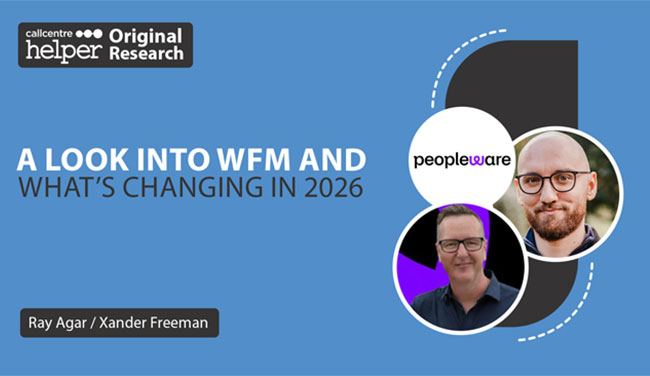
As part of the latest Call Centre Helper research, we set out to understand how workforce management (WFM) is evolving across the contact centre landscape and beyond, digging into the growing use of AI in WFM and the shifting expectations of the workforce.
To help make sense of these results, we sat down with Ray Agar from Peopleware, sponsor of the WFM section of the research, to explore what the data really tells us about where WFM stands today, what’s holding teams back, and how AI is beginning to reshape the discipline.
WFM has sometimes lived in its own bubble within the customer contact world – a specialist discipline that can often be siphoned off from the wider industry conversation.
But that separation is disappearing fast. Our latest research illustrates how WFM is rapidly being adopted into the wider customer contact landscape, and how in turn it has been impacted by industry trends.
One of the most striking findings is just how far WFM adoption has come. Ten years ago, only around 30% of organizations were using dedicated WFM technology. Today, that figure sits at 64%. That’s a huge shift – and it didn’t happen by accident.
Organizations are slowly but surely realizing both the benefits of WFM and the limitations of the tools they’ve relied on for years.
Spreadsheets still hold their ground, with around 60% of organizations continuing to use them, but it is easy for cracks to begin appearing as operations grow in size and complexity.
Spreadsheets and Erlang calculators can produce a forecast or a basic schedule, but what do you do once you need real-time management? Not to mention once you introduce multichannel demand, complex shrinkage, or integration with CRM and call data.
At a certain scale, spreadsheets become unmanageable. Reporting becomes manual. Real-time decision making becomes reactive rather than proactive, and the very people responsible for WFM – often time-poor professionals being asked to do more with less – simply don’t have the hours to keep patching systems together.
Modern WFM platforms offer a unified approach. Forecasting, scheduling, real-time adherence, reporting and optimization all live in one place.
As contact channels multiply and customer behaviour becomes harder to predict, that unified view starts becoming essential.
WFM doesn’t exist in a vacuum. It reflects the way people want to work. Scheduling trends tend to come in cycles, but some themes are especially strong right now.
Staircase (or step) shift scheduling has seen a surge in popularity, particularly in the US, and condensed work weeks are also gaining traction.
Technology providers are responding by doing something refreshingly simple: listening. Vendors like Peopleware are actively engaging customers to understand what both agents and workforce planners actually need.
The move away from rigid, fixed schedules toward more flexible, human-centred models is no longer optional. It’s a necessity for retention.
Fairness is a big part of that conversation. Weekend equity, late-shift distribution, night shifts, hybrid and homeworking arrangements are all factors that need to be designed into WFM systems from the ground up. Products need to adapt to the reality of modern working lives, not the other way around.
As many organizations encourage employees back into the office after Covid-19, WFM teams are facing a new mix of challenges and opportunities.
Some people are returning to office environments they’ve never worked in before, bringing in the need for additional training, re-onboarding, coaching and structured one-to-ones.
All this and more creates extra demand on already stretched planners. Situations like this create the perfect opportunities for AI to step in and handle the heavy lifting, allowing humans to focus on judgement, insight and care.
Interestingly, AI adoption in WFM still lags behind other areas of customer contact. Just under 60% of organizations surveyed say they aren’t currently using AI within WFM. Just what is it that’s holding them back?
Speaking to Ray, it was clear that this headline figure hides a more nuanced story.
“The definition of AI is a little bit blurry.”
AI means different things to different people, which can sometimes make it a little bit hard to pin down. For some, it’s simple automation and rule-based execution.
For others, it’s advanced optimization engines or sophisticated forecasting algorithms – the kind already embedded in many modern WFM platforms such as Peopleware. In reality, AI has been part of WFM for years; it just hasn’t always been labelled as such.
Many organizations still rely on tools that simply don’t have AI built in. Others may not realize that features like forecast or shift optimization are AI-driven.
Much like CX, AI has become a broad, sometimes vague umbrella term, often disguising capabilities that have been quietly delivering value all along.
The good news is that AI is creeping in, perhaps just not at the breakneck pace the hype might suggest. Vendors are steadily building it into more areas of the WFM lifecycle, and demand is clearly there.
Starting to implement AI into the WFM strategy can feel overwhelming. It can be difficult to know where to start, which is where Ray’s advice comes in: understand what’s available.
Talk to vendors, ask for demos, and be specific about what it is you’re after. Don’t accept “AI-powered” as a buzzword – ask what the product actually does.
Focus on the processes that drain time and energy: the repetitive, labour-intensive tasks that eat into strategic thinking, and ask how technology can streamline those processes without stripping away the human touch that makes workforce management so effective.
It also helps to experiment outside of WFM. Try other AI tools, build familiarity, develop confidence. Many professionals already use AI-adjacent tools without even thinking about it, they just don’t call it AI.
For anyone feeling overwhelmed with the idea of introducing AI to WFM, just think back to the Microsoft paperclip and how it compares to modern chatbots.
The technology isn’t all that different – new technology often looks shiny and revolutionary, but at its core, it’s all about helping you get where you need to go.
To find out what else was uncovered in the report, download it for free now: What Contact Centres Are Doing Right Now

Xander Freeman, Director, Call Centre Helper
Xander is a regular host and moderator of webinars, interviews, and live panels on a wide range of topics in the customer contact space – sharing insights on CX innovation, AI, workforce management, and more.
Connect with Xander on LinkedIn
Read more by Xander Freeman

The Latest Customer Contact Research, Reports and White Papers straight to your inbox!
Get the latest insights from Call Centre Helper by signing up for our email content.
Close


14th October 2026
18th October 2026


