





In this article, we take you through the key aspects of training objection handling, which will help your agents to overcome sales objections over the phone.
Listen to Fully Understand the Objection – Is It Genuine?
It is too common for an agent to hear an objection and then go into a “defensive mode”, launching lots of unnecessary information at the customer. We need to take the time to clarify what the customer is telling us.
Reflective Listening
To do this, we need to train agents how to use reflective listening. This is a technique where the agent reflects the customer’s query back to them, using their own language, to highlight that they’ve completely understood what has been said.
For example, the sales agent will say something like: “What I’m hearing is…” and then repeat back the customer’s concern, to confirm that you have mutual understanding.
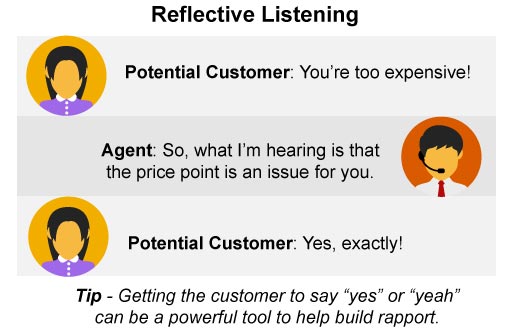
Then, once the agent has developed a clear understanding of the customer’s objection, they need to find out if it’s “fob off” or a genuine objection.
Jacqui Workman, Owner and Manager at KMB, says: “If it’s a ‘fob off’, i.e. the customer says that they have ‘no time’ or they want you to ‘put it in an email’, then I would suggest that you ‘back out’ gracefully.”
To back out gracefully, find out when a good time to discuss the product/service will be and end the call on a positive note. This keeps open lines of communication for the future, when they might be more willing to speak.
To back out gracefully, find out when a good time to discuss the product/service will be and end the call on a positive note. This keeps open lines of communication for the future, when they might be more willing to speak.
But don’t stop there, as Jacqui says: “Revisit the call flow to find out if there was an opportunity to probe earlier in the call, so that you can provide better benefits that are specific to the prospect and strengthen the call during the next conversation.”
If it a genuine objection that keeps coming up, then it may be worth building it into the call flow early on. For example: “I understand that you may have had a bad experience with x in the past. However…”
The ABC Principle
Now we know that the objection is genuine, we need to acknowledge the customer’s problem directly. Do not avoid it and launch into a sales pitch.
Jacqui Workman adds: “Always acknowledge the objection. If you don’t, then it sounds like you are not listening to what they have to say and trying to railroad them into what you want – not what they need.”
But don’t leave it there! This is just the first part of Michael Melhado’s ABC strategy for overcoming customer objections, which he introduced to us in our article: “5 Tips to Improve Your Call Centre Sales“.
In the article, Michael, the Director of Luther Marketing Group, says that – after you’ve acknowledged (A) the customer’s objection – you should then bridge (B) and close (C).

Michael Melhado
For example, if a customer says that they are too busy to take the call, after showing acknowledgement, Michael recommends that you “talk about how the product or service that you are trying to sell can help busy people. This a classic example of bridging from the acknowledgement to your product/service.”
“Once you’ve made this connection, between the objection and how your product/service can overcome it, revert to some of the messages that we planned to use in the pitch – this is the close, as you should now be back on track.”
This is a great methodology that is easy for sales agents to follow, and if they can think of ways to “bridge” the most common objections back to the sales pitch and test them in role-play situations, you can really boost your contact centre sales.
For more innovative approaches to objection handling like this, read our article: 10 Strategies for Overcoming and Handling Objections in Sales
Help Agents to Prepare for Common Objections
Sales agents should role-play common objection scenarios, until handling these situations feels natural.
As Jacqui Workman says: “Once it feels natural it will sound more natural over the phone and should become a seamless part of the call flow.”
With this in mind, below are eight common sales objections, each with our advice for how to prepare for them, which can be passed on to agents, in the hope of creating natural and positive sales conversations.
The Top 8 Sales Objections (And How to Overcome Them)
1. “I’m not authorised to sign this off”
If the potential customer says that they are not the decision maker, then that should have been identified straight away, before you started pitching to them.
Find out whose decision it is. Contact them and introduce yourself using a reference to your previous contact.
However, if you are ever in this situation, Carolyn Blunt, MD at Ember Real Results, says: “Find out whose decision it is. Contact them and introduce yourself using a reference to your previous contact.”
Remember, though, just because you are not talking to the decision maker, this doesn’t mean that you have authorisation to be pushy with them or to pitch to them.
If you’re pushy, it may leave a negative impression of your business within their company. Or, if you pitch to them and they pass the message-on, it will never be as passionate as your original version.
2. “We don’t have any budget”
How you overcome this objection will depend on how close you are to having new budgets set and your company policy on exploratory meetings.
After all, people can’t make informed decisions without having a comparable quote or may need quotes to put into the next budget anyway.
Jacqui Workman says: “If at the end of the day they are not at the right time to buy, then ask them when they are reviewing, not renewing, as that is too late.”
3. “We’re already have another supplier”
Are they happy? If so, there is little you can do, but at least they know about you now. Will they consider allowing you to do a proposal alongside their current suppliers next time? There is nothing to lose from considering all the options.
As Jacqui says: “This is often the case with all calls. In fact, I would make the assumption and ask who they currently use early in the call and build an objection around comparing with the existing supplier.”
Do your homework on how well your product/service matches up with your main competitors – looking out for all the possible advantages
While it’s important to remember never to bad-mouth your competitors, when you prepare for this common objection, do your homework on how well your product/service matches up with your main competitors – looking out for all the possible advantages.
Carolyn also recommends: “Ask if you can send some literature for them to keep on file. You never know – they may fall out with their current provider or the current provider may not be able to meet their needs. You need to be in the right place (forefront of their minds!), at the right time!”
4. “I’m busy at the moment”
Revert to the ABC principle, after you have established that this is a genuine objection, by firstly acknowledging that they’re busy. Then, explain how the product can help busy people and revert to your sales pitch.
If you are able to make the decision to buy your product a “no-brainer” for people who are in their exact situation, they will likely be much more willing to listen to you.
5. “You’re too expensive”
To overcome this objection, Carolyn Blunt recommends that you start by respectfully asking a few probing questions, such as:
- “What is the ball park figure you would expect to pay for such a product/service?”
- “Do you have an idea how much our products/services cost?”
- “Have you had a cheaper price/quote/bid from elsewhere?”
If the customer is right in that your price tag is too high, think about their values and how, despite the price tag, your product relates to these values, making it such a good fit for them.

If the customer is right in that your price tag is too high, think about their values and how, despite the price tag, your product relates to these values, making it such a good fit for them.
With this in mind, Carolyn suggests saying something along the lines of: “We may be slightly higher in price than company X, but you mentioned earlier that a reputable company is important to you. We only work with the quality end of the market and provide a high level of service using only the best, most experienced people.”
6. “I’ll think about it…”
Again, this is an objection where we have to consider whether it is a “fob-off” or genuine. In this case, it’s most likely the former. However, be prepared for the off-chance that it’s not.
Carolyn suggests that you respond with: “Thanks for agreeing to think about it, I appreciate that. Is there any more information you need that I can provide?”
Then, look to follow this up with a second question: “When would be a good time for me to contact you again?”
These two questions help to maintain positive lines of communication, making your product/service the obvious choice, when the “thinking” really does happen.
7. “We used you before, it wasn’t that great”
This one is tricky, as bridges need to be built. So you need to offer a sincere apology. But in order to do that, you must find out when the potential customer last used your product and what happened.
By finding out what has happened in the past, your apology will sound more authentic, while you are directly acknowledging the customer’s concerns.
By finding out what has happened in the past, your apology will sound more authentic, while you are directly acknowledging the customer’s concerns.
Next, you need to “bridge” and “close” the objection, which you can do by telling them what has changed and how you’d like to help them.
Also, if you are allowed to, then offer a sweetener if they will try you again (free gift).
8. “Your company is too small/never heard of you”
The key here is to find out what the customer is really saying, by asking them: “May I ask what are your worries about that?”
In response, the customer will likely say that they think you are not equipped to handle their needs or they may think that you aren’t reputable.
To overcome this objection, Carolyn recommends that you “offer reassurance in a non-defensive way. In this case you could mention names of other clients, testimonials, references, awards, etc.”
“Then, ask ‘If you knew we could meet your needs would you be interested in speaking with us further?’”
Coach Sales Agents to Deal With Common Customer Personalities
When handling customer objections, you’ll come across common scenarios where a customer wants to haggle, is tentative or just wants to hang up straight away.
For when an agent finds themselves speaking to such a customer, here is some handy advice to pass on to them – as suggested by Jacqui Workman.
Haggling Customers
How you handle a haggling customer really depends on how much power you have to negotiate in the first place.
How you handle a haggling customer really depends on how much power you have to negotiate in the first place.
If you have some flexibility, then great, but if not, then you need to use your objection-handling skills to highlight that while there is no movement in price, the benefits outweigh the bit of money that they would be saving elsewhere.
Tentative Customers
You need to understand what will help the customer make that decision, and you can only do this by finding out what is most important to them.
So, you could try to use soft close techniques that involves matching back appropriate benefits.
A Customer Who Wants to Hang up Right Away
If the customer is saying they are not interested straight away, ask them why? This can lead to an opportunity to handle the objection.

Jacqui Workman
Whenever a customer just sounds like they are not that interested, then you either need a bigger benefit or you are talking too long in the first instance.
Remember the first moments of a sales call are imperative, as it doesn’t take long for a person – in any scenario – to make their mind up about someone. So, engage the potential customer early by asking them a few questions.
Train the Following Technique for Confidently Closing the Call
Closing the sale is a critical step. A decision that is deferred is usually never made.
So Carolyn Blunt recommends that you “ask the magic question ‘how does that sound to you today?’ If a customer comes up with objections, remember that this is good – it often means they are seriously considering buying.”
“If they just say ‘no thanks’ or ‘can you put it in the post’ then it is important to politely enquire, ‘I can, but so I can help, may I ask what is stopping you from deciding about this now?’”
If a customer comes up with objections, remember that this is good – it often means they are seriously considering buying.
Once you know the objections, you can overcome them or offer alternatives. Good sales practice will state that it is vital not to give up at the first hurdle.
However, depending upon your particular customer profile, please proceed with care. Handling objections will always be much easier to do if you have established rapport and created interest and desire.

Carolyn Blunt
Carolyn continues: “Sometimes the reason for not buying is outside of your control and it is important to know when to desist and not be ‘pushy’. When you work to overcome objections you need to do so in a friendly advisory capacity with a warm even voice tone.”
“A lot of the time people do need reassurance to make buying decisions and this is what they are often crying out for at this stage. If you don’t believe your products or services are a good investment and the right choice, then who will?”
Role Play, Role Play and Do Some More Role Playing!
When training objection handling, there is no better training exercise than role play.
While everyone may dread role plays, they are a great way for people to practise what to say and how in a safe environment. This means it’s so much easier when it comes to putting it into practice in the real world.

Caroline Cooper
This is according to Caroline Cooper, a Trainer and Consultant at Naturally Loyal, who says: “Let your team write their own your objection handling scenarios to suit your business, your specific situations and seasonal variations.”
“But make these less intimidating by running in small coaching groups with another team member acting as observer in each group.”
Once role-played, the observer should be asked whether they would have done anything differently, while also giving positive feedback. This helps to further the learning, as well as giving the sales agents a nice bit of encouragement.
For more training exercises recommended by Caroline, read our article: 9 Fun Customer Service Training Exercises
Make Use of Your Call Recording System
There are hundreds of different possible objections that sales agents will face at one point or another and having a call recording system will mean that you can identify sales objections.
If you record all your calls, you already have access to every objection ever used and every way agents have tried to overcome them, so you can analyse which approaches have and haven’t worked well.
With a speech analytics system you can also identify the most frequently occurring objections. You then can tag the various ways agents try to overcome the objection and identify which are most effective.

Frank Sherlock
This process is recommended by Frank Sherlock, VP International at CallMiner, who says: “With this information, you can set up alerts so when certain phrases are said such as: ‘That price is too much’ another offer or script can pop up for the agent to use that can assist the sale.”
“You can then share this best practice with other agents to improve their performance.”
In Summary
First train sales agents to use reflective listening to ensure that they fully understand the customer’s objection and can clarify whether it is genuine or not. If it’s not, it may be best to bow out gracefully.
However, if the objection is genuine, coach agents to use the ABC principle to firstly acknowledge the customer’s concern, then to bridge that concern by linking back to the product, and then close by reverting to the original pitch.
This is a great tip, but, for your most common objections, it’s best to prepare agents a little more and role play, to ensure agents are confident in handling them.
Finally, coach agents how to deal with objections from difficult customer types, such as hagglers and fence-sitters, to ensure they feel confident in any given scenario.
For more outbound sales advice, read our articles:
- The Right Words and Phrases to Use on a Sales Call
- Top Tips for Selling Over the Phone
- 21 Top Tips for Appointment Setting
Originally published in September 2010. Recently updated.
Author: Jonty Pearce
Published On: 29th May 2019 - Last modified: 14th Aug 2025
Read more about - Skills, Call Handling, CallMiner, Caroline Cooper, Carolyn Blunt, Handling Customers, Jacqui Workman, Objection Handling, Outbound, Skill Development, Telesales, Training and Coaching















Problem is, there are so many different training methods, closing skills, SPIN, 7 steps, impulse techniques etc…
who’s ever right? however though these are some good BASIC knowledge skills, though there are some I wouldn’t agree with.
Hi Darren, thanks for the feedback, I’d be interested to know what market you’re selling to and what objections you face regularly, as I may be able to give some more specific and advanced ideas to you if it would be helpful. Thanks again, Carolyn
Hi Carolyn, I think there is some great content above. I am a training manager and think that there is alot of different views / opinions and training out there and the way I like to train my team is to give their audience tools to use in as many situations as possible, there are some greats tools here.
Andi
Great tips there! I find’It’s not the top of my priority list’ is a common objection, but at least it’s not a NO! – so reqular follow up’s are important.
Darren – its not about what techniques are correct, but arming your consultants with as many as possible for your business and then letting them master the ones that work for them.
Can you please give me answers on this objectives
1.Your product is too new
2. Business is slow right now.
3.The machine we have is still good
I don’t spend much on this phone so I don’t need any calling plan. How do you handle this.
great tips. i sell advertising space but have only been doing it 1 yr. how do you keep your spirits and confidence high when your not selling?. im in telesales
How do l get every day tips
I’ll think about it……“When would be a good time for me to contact you again?”
You’ve just let the customer go and have entered the endless cycle of call backs.
I have worked in mobile sales company in salford quays yrs ago and I’ve worked in call centers for 5yrs so I’ve had my share of that experience :).
To be honest giving tips does help to develop and train newcomers in sales environment.for staffs that have been working in sales and still not selling or haven’t got skills of handling objections I will blame the organisations in most cases,some call center managers don’t care about their staffs all they care about is sell sell sell,or the famous word ‘you’re not hitting target we will review you at the end of the week’meaning you might get sacked, why do they think threats will work?instead of encouraging the staff and see how to help them improve their performance through further coaching or training or motivational talks.
Its just like in sports be it individual sports or team sports,the coach or trainer or even fans motivate the sportsman which helps build back confidence and winning ways.another thing that helps improve productivity is motivation in a team,good atmosphere in the contact center does help improve staff morals and always wanting to come to work. Also little incentives to staffs that gets a deal or that has the highest sales for the day does help the team spirit and improve productivity.Another thing is try encourage your staffs to be professional at all times.
I will love to be a call center manager or customer service manager one day and the team i will manage will be the happiest team and they will always want to come in work why because they will be treated as humans and having a good team relationship where we are there for one another helps alot. anyway this is just my opinion.
free advice ,when a client tells you that the product you are selling is too expensive ,do not just give up ,ask the client if she/he budgets for their groceries ,and if so how many times did they spend exactly the amount they have budgeted to spend.make the client see that they can afford your product ,its just that they cant realise so…second example you can kindly ask your client if they smoke and how many smokes do they have per day then ask them if they could reduce their smoking and show them exactly how much they could save ,calculate for your client the exact amount they spend per day on smoking and per month.
Barry is right, you don’t want to join the endless list of call backs…
Excellent tips, many thanks
Its all about the one percent-ers. I have picked up a couple from your article. Thankyou
HI THANK YOU FOR ALL THE TIPS,I HAVE LEARNT ALOT,I AM A TELESALES CONSULTANT AND I WAS SEARCHING FOR THE ANSWERS TO MY QUESTIONS……….