The Largest Online Community for Contact Centre Professionals


The Largest Online Community for Contact Centre Professionals
 Close
Close


Published On: 17th Mar 2026 08:00 - Modified: 25th Mar 2026
If you’ve ever opened a website and been greeted by a little speech bubble asking “How can I help you today?” – you’ve probably met a chatbot.
If you’ve ever had a chat that actually understood you and helped solve your problem without going in circles, you’ve probably met an AI agent.
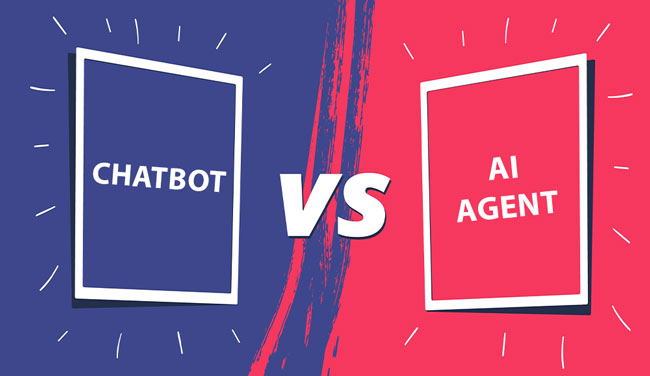
So, what’s the actual difference between a traditional chatbot and an AI agent? Are they just different names for the same thing? Not quite! Here are the key differences to be aware of.
While they may both sit in the same chatbox on the screen, what’s happening behind the scenes, and the results a customer gets, are worlds apart.
At the most basic level, traditional chatbots are rules-based. Think of them like a decision tree: if the user says X, respond with Y. They follow pre-set scripts, relying heavily on keywords or exact phrasing to give the customer a matching answer. It’s a bit like speaking to an interactive FAQ.
AI agents, on the other hand, are powered by large language models (LLMs) and machine learning. That means they can understand the intent behind what a customer is saying – even if they don’t phrase it perfectly.
They don’t just pull pre-written responses out of a drawer; they generate answers dynamically, based on context, memory, and real-time reasoning.
For expert advice on if chatbots are universally hated, read our article: Are Chatbots the Tech We All Love to Hate?
Have you ever had to repeat yourself over and over again to a chatbot? That’s because most of them have little to no memory. They treat every message like it’s a first, which can get frustrating for customers quickly.
By contrast, AI agents are designed to hold context. They can remember what a customer said earlier in the conversation (and in some cases, in previous conversations), helping them build a more natural, humanlike interaction.
It’s the difference between talking to a call centre robot and chatting with a smart assistant who knows their name, their preferences, and their history.
Chatbots are best for basic tasks: checking opening hours, tracking an order, resetting a password – that sort of thing. They thrive in scenarios with clearly defined questions and limited scope.
AI agents, however, shine in complex or high-stakes situations where the conversation could go in a hundred different directions.
Think: troubleshooting technical issues, helping customers navigate tricky refund policies, or even upselling a tailored product recommendation based on their behaviour and preferences.
In other words:
One of the biggest limitations of traditional chatbots is that they’re static.
They can’t learn from past conversations unless someone manually updates their scripts. That means their performance depends entirely on how well they were set up in the first place.
AI agents, however, are designed to get better over time. They use techniques like reinforcement learning, sentiment analysis, and feedback loops to continuously improve how they respond.
In enterprise systems, this might be supported by human-in-the-loop training – where teams review and fine-tune agent behaviour for even better outcomes.
Most chatbots act as glorified menu systems. They ask the customer to pick an option, then guide them through a pre-built flow. At best, they might help them find the right webpage.
AI agents are built to complete tasks – not just direct customers to where the task can be done. They can initiate actions on a human agent’s behalf, like updating account information, booking appointments, or changing delivery addresses. This autonomy makes them feel much more like a real assistant rather than an interactive pamphlet.
Traditional chatbots often work as standalone widgets or plug-ins. They live on your website or within your app but aren’t deeply woven into your backend systems.
AI agents are typically more integrated – they need access to your CRM, order management systems, helpdesk software, and more in order to function effectively. This deeper integration means they can surface richer insights, trigger workflows, and act on real-time data.
So, while a chatbot might say to a customer, “Sorry, I can’t access your account right now,” an AI agent could say, “I see you’ve had a failed payment – would you like to retry that now or speak to someone on our billing team?”
Even the best traditional chatbots tend to sound… robotic. That’s because they’re selecting from a fixed bank of responses, often written with legal or brand-safe phrasing in mind.
AI agents have a much wider expressive range. Because they generate language dynamically, they can adapt their tone depending on the customer, the topic, or even the time of day. They can be formal, friendly, cheeky, empathetic – whatever your brand needs them to be.
This is especially powerful in industries like hospitality, retail, and luxury services, where tone of voice can make or break the customer experience.
If you want advice on how best to use tone of voice, read this article: How to Utilize Tone of Voice in the Contact Centre
Let’s talk budget. Traditional chatbots are cheaper to implement. They’re relatively quick to set up, easy to maintain, and good for covering basic support needs without breaking the bank.
AI agents, meanwhile, require more upfront investment – not just in terms of software, but also data preparation, integration work, and (in some cases) ongoing fine-tuning. But the payoff? Dramatically higher resolution rates, happier customers, and lower support costs in the long run.
It’s a classic short-term vs. long-term decision. If you’re scaling quickly or dealing with complex customer needs, AI agents usually pay for themselves.
There’s no right or wrong answer here.
Traditional chatbots are still incredibly useful, and you can tailor your chatbots to your needs – particularly in sectors like:
However, it’s worth keeping in mind that AI agents are better suited to:
Ultimately, choosing which one is best for you depends on your contact centre goals, budget, and how deep you want to go with automation. In fact, many businesses use both: a chatbot for quick wins, and AI agents for deeper engagement. Either way, investing in the right tech for your specific needs and using it well will make all the difference.
That being said, it’s equally important that you don’t overlook the need for choice and appealing to different customer demographics.
“The role of chatbots, AI agents and – let’s not forget – live agents is dependent on understanding the context of what a customer is trying to do. The key to good CX is to deliver intent-driven engagement with customers through their preferred channel via their device of choice. For example, that means offering different solutions for ‘transactional’ support, where digital self-service is applicable, versus ‘discussions’ around the problem the user is experiencing, where finding workarounds is something where community or live agent support is better suited.

You also need to think about customer demographics. In the age of Alexa, Co-pilot and Siri for Gen Z millennial customers, WhatsApp, Facebook Messenger Chat and Apple Business Chat are the required features within an omnichannel world. Don’t force them to call.
And when customers do pick up the phone, then reimagine IVR as AI-powered speech, drawing on the same natural language processing engine and business logic used by the AI agents who are their text-based counterparts. These multiple use cases could give a better ROI for the AI agent tech investments required.
Expect the outcome to be differentiated user solutions across your acquisition, onboarding and customer service journeys.” – Paul Weald, The Contact Centre Innovator
For more information on how technology can be used to improve CX, read these articles next:

Stephanie Lennox is a 2x internationally bestselling author, speaker, and business strategist. Currently, she brings her vast wealth of expertise to Contact Centre Helper, leveraging her skills in communication and audience engagement to create impactful, customer-centric content.
Her work here is an extension of her passion for technology, business communication, and humanising the customer experience – all while contributing to her overarching mission of helping creatives and business owners thrive in online spaces.
Connect with Stephanie on LinkedIn
Read more by Stephanie LennoxReviewed by: Jo Robinson

The Latest Customer Contact Research, Reports and White Papers straight to your inbox!
Get the latest insights from Call Centre Helper by signing up for our email content.
Close


14th October 2026
18th October 2026


