


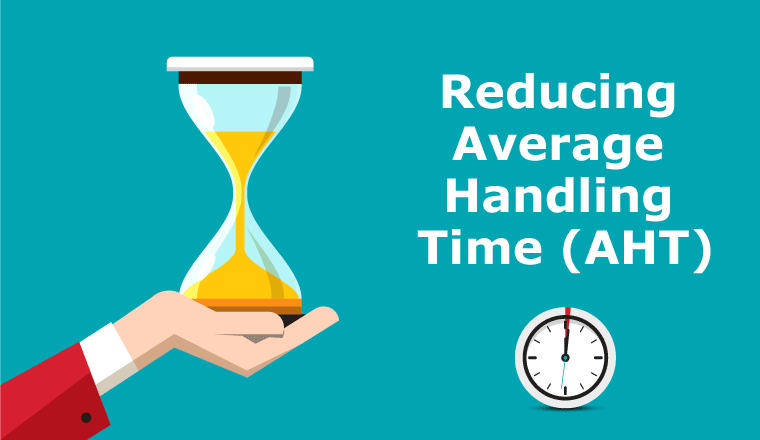
Reducing Average Handling Time (AHT) is a key focus for many contact centres, as it helps improve efficiency while maintaining excellent customer service.
That’s why we asked our Call Centre Helper reader panel for their advice on reducing Average Handling Time in the contact centre.
How to Lower Average Handling Time (AHT)
Here are 32 ways to reduce call centre average handling time:
1. Create Cheat Sheets to Help Streamline Call-Handling Processes
I recently analysed on-hold reasons and compared them against different agents handling the same types of calls. We found that agents were using different methods to get the same information from the systems.
To address this, we created cheat sheets for popular call types and streamlined our call-handling processes for the more common queries.
Contributed by: Mark
If you want a free training cheat sheet, take a look at our article: Training Cheat Sheet – Handling Customer Objections
2. Let Agents Listen to Examples of Low AHT
Agents with higher AHT can benefit from listening to calls handled efficiently by colleagues with lower AHT. This gives them a clear example of how they can achieve a lower average handling time.
By reviewing these calls, agents can identify key techniques or practices that contribute to quicker resolutions.
They can then incorporate these strategies into their own calls, which can improve efficiency. Sharing these examples promotes ongoing learning and continuous improvement among the team.
Contributed by: Antony
3. Nip Problems in the Bud by Paying Special Attention to New Staff
Call monitoring can have a big impact, especially with new staff, as they can learn effective time management from the outset.
By monitoring their calls from the outset, you can identify training gaps and provide the agents with valuable feedback about the call. This process works well for our company in keeping our handling time within targets.
Contributed by: Janet
For a free call monitoring and evaluation form, check out our article: Free Call Monitoring and Evaluation Form – Excel Template
4. Identify Silence on Calls
Calls with excessive silence can prolong handling times and make the customer feel awkward. By identifying these calls, you can pinpoint agents who may need additional training to handle conversations more efficiently.
Training agents to avoid unnecessary pauses and engage customers consistently can reduce AHT. This approach not only shortens call duration but also improves First Contact Resolution (FCR) and Customer Satisfaction (CSAT). Addressing silence during calls ensures a more fluid and productive interaction with customers.
Contributed by: Denis
For more advice on avoiding silence on calls, read our article: Seven Tips to Avoid Dead Air Time in Phone Conversations
5. Buddy-up Agents
One way to reduce average handling time is to pair agents with a high AHT with those who consistently handle calls efficiently. Listening in on each other’s calls can highlight techniques that reduce call time without sacrificing quality.
It’s important to ensure that there’s a calibration process in place, so both agents are aligned on quality standards. This buddy system creates idea-sharing and helps high AHT agents adopt more effective methods. Over time, this collaboration leads to improved AHT across the team.
Contributed by: Trisha, Charlie & Alexander
6. Appoint Staff Champions
Give staff champion roles within a specific service. Make staff aware of who is the champion for each service.
Advisors should attend meetings with back office within their champion role and bring back updated information, for example street scene, bad weather warnings, etc.
7. Train the Habits of Highly Effective Agents
Examine the habits and techniques of your top ten agents to identify what makes them consistently efficient in handling calls.
Once identified, share these tips with your lower-performing agents to help them improve. Targeting the slowest agents will likely produce the most significant improvements in AHT across the team.
Contributed by: Andrew
8. Keep Customer Profiles Up to Date
Update the customer profile at first point of contact. This way there is no confusion when giving feedback to the customer on services requested.
Ensure that the caller history is up to date with all previous conversations with the customer, no matter which agent has spoken to them.
The enquiry can then be picked up so that this is seamless to the customer. Staff can log on at different locations to reduce call handling time when a high volume of calls is being received.
The customer often may repeat the same information to different members of the team. Creating a 360-degree of the customer prevents needless sharing of the same information that can lead to irate customers.
9. Take a Look at the Health of Your Contact Centre Ecosystem
To truly optimise your team’s efficiency, it’s essential to examine the support systems your agents are using. Are the tools they rely on helping them work efficiently, or are they creating unnecessary barriers? Consider the following points to identify potential issues:
- Does the ecosystem inhabited by your agents help or hinder them?
- Do they have to copy and paste from one system to another?
- Are your agents asking customers for information you already have in your systems?
- Are your knowledge resources rapidly returning helpful results or do your agents have to wait seconds or even minutes?
- Do they have to search more than once during the same call to answer the customer’s question?
- How many separate tools do you expect your agents to juggle?
By taking this kind of approach, I have seen AHT reduce by up to 25% within a matter of weeks.
Contributed by: Jason
10. Share Information on Repeated Questions
Encourage staff to share insights and solutions to frequently asked questions to minimise repeated inquiries.
By collating and distributing these common queries and effective answers within teams, you can reduce the time spent on repetitive tasks.
This sharing of information helps agents quickly access the right responses, leading to faster resolutions. It also promotes collaboration and ensures that the team is aligned on the best ways to handle recurring issues.
11. Encourage Staff to Do the After-Call Work (ACW) During the Call
We encourage our staff to do the After-Call Work (ACW) during the call. This stops customers feeling rushed and reduces AHT. It also gives the customer the confidence that their query has been fully dealt with.
If agents are having to add notes to the account after the call then you need to find out why this is the case. Why do they feel as though they are unable to do so during the call? The agents can then plan their calls better, to improve their AHT.
Contributed by: Teresa and Stewart
For more ways to reduce after call work, read our article: What Is After Call Work (ACW) and How Can It Be Improved?
12. Keep the Customer Updated So They Don’t Fill Silence With Small Talk
If it is absolutely necessary to go silent when processing things, advisors should keep the customer ‘in the loop’, e.g. “Sorry to keep you waiting, I’m just updating the account.”
That way the customer doesn’t feel the need to fill the silence with conversations that can ultimately prolong the call and distract the advisor.
Contributed by: Gina
13. Gather All Information at the Start of the Call
Encourage agents to gather all relevant information at the start of the call to set a clear direction for resolving the issue.
By collecting key details upfront, agents can avoid interruptions and reduce the need for repeated questions during the conversation. This allows them to address the issue more efficiently and with a clearer understanding of the customer’s needs.
Contributed by: Nicola
14. Look Carefully at the IVR
Problems can be caused by customers choosing the wrong options on the IVR. Carefully examine your IVR options and see if there is a way of avoiding these problems.
Also, try to include regulation information within the IVR rather than agents having to read and confirm information from scripts or training updates.
Contributed by: Robert
15. Recruit Agents Who Speak Concisely
When recruiting, focus on candidates who naturally communicate in a clear and concise manner. Look for individuals who can ask direct, relevant questions and provide straight-to-the-point answers.
This ability reduces unnecessary talk, speeding up call resolution times. Agents who communicate efficiently help minimise AHT without sacrificing customer service quality. Prioritising concise communication during hiring ensures your team is equipped to handle calls quickly and effectively.
Contributed by: Antony
16. Use Call and Screen Recording
Utilise call and screen recording tools as a coaching resource to help reduce AHT. These recordings allow managers to review interactions and pinpoint areas where agents can improve their efficiency.
By analysing both the call and the screen actions, agents can receive targeted feedback on how to streamline their processes. This tool also enables agents to review their own calls, identifying opportunities for quicker resolutions.
Contributed by: Bart
17. Simplify Marketing Materials
If your team is frequently receiving calls for clarification on complicated marketing materials, work with your marketing department to simplify these resources.
Clear, easy-to-understand materials reduce the need for customers to call in for explanations. By proactively addressing potential confusion, you can lower call volumes and ensure agents spend less time explaining details.
For advice on how to improve your communication with other departments like marketing, read our article: 7 Clever Ways to Improve Internal Communication Between Departments
18. Turn off the Queue Displays on Walls
We found that agents worked more efficiently when they didn’t know how many calls were queuing. When the queue was visible to them, they extended their call beyond what was necessary in an attempt to have a bit of a breather.
By removing this visibility, agents focused more on resolving the issue at hand quickly, without the pressure of the growing queue. However, this was on a technical support account, so it may differ depending what sector you’re working in.
Contributed by: David
Take a look at our article, to find out: What Information Should You Be Displaying on Your Contact Centre Wallboards
19. Implement a Mentoring Program
Select enthusiastic and skilled agents to mentor new recruits, helping them adopt best practices and effective habits from the start.
Mentors can share their experiences, provide guidance, and offer insights that help improve quickly. This can help start new agents of on the correct path and enables them to become proficient faster.
Contributed by: Carly
20. Record All of Your Calls
Record 100% of calls received for training purposes. This then enables you to listen to long and short calls. This should allow you to see if there is a training issue.
Long calls may be a sign of the agent not listening to the problem, interrupting the caller or being unable to take control of the call.
21. Involve Staff and Supervisors in Creating Training Materials
Involve both agents and supervisors in the creation of training materials to ensure they stay updated on best practices. This approach allows experienced staff to share real-world insights while also reinforcing their own knowledge.
By actively participating, agents can refine their skills and stay aligned with evolving processes. Supervisors can also identify common challenges and tailor training to address them effectively.
Contributed by: Teresa and Stewart
22. Use the Same Advisor for Callbacks
Use the same member of staff to deal with callbacks from the original call. The customer will be talking to the same advisor and will feel more valued.28. Create Friendlier Forms
Create more user-friendly service request forms for every scenario with a specific service. This gives a more consistent approach for the customer.
23. Make Your Knowledge Base Searchable
Integrate a robust search engine into your knowledge base to help agents quickly find the information they need. A well-structured, easily searchable database reduces time spent looking for answers, leading to faster call resolutions.
Ensure that content is indexed properly and optimised for common search terms. The quicker agents can access accurate information, the lower the AHT and the better the customer experience.
Contributed by: Yasmeen
Find out more about managing your knowledge base by reading our article: An Introduction to Call Centre Knowledge Base Software
24. Educate Agents on the Balance Between AHT and Service
Tracking AHT alongside customer feedback helped us identify the optimal handling time for different call types. This analysis showed that longer calls don’t necessarily lead to better service, in fact, efficiency and clarity often improve customer satisfaction more.
By sharing these insights with agents, we helped them focus on resolving issues effectively rather than extending calls unnecessarily. Setting realistic AHT targets ensures a balance between speed and service quality.
Contributed by: Craig
25. Produce a Set of Troubleshooting Questions
Develop a structured set of troubleshooting questions to help agents diagnose issues efficiently. A clear, step-by-step flow ensures consistency, reducing the need for agents to improvise on each call.
This approach minimises unnecessary back-and-forth, improves accuracy and ensures that all agents follow best practices.
Contributed by: Maheswaran
For lots of great questioning techniques, read our article: 6 Effective Questioning and Probing Techniques for Customer Service
25. Share Agent Best Practice
Encourage your top agents with the best call control to share their experiences/strategies with colleagues in team briefings. It’s more powerful than coming from a team leader or manager as agents can see it really works.
This extends to letting agents pull some of their calls and listen to them and I guarantee they will hear the customer driving the call and that they had been repeating themselves.
Agents may also notice that the call info and questions were out of sync, meaning that they had to go back and get the info again.
Also, agents can listen for open and closed questions in the wrong part of the call, open at the front, closed at the end. They may be using them in the opposite places, therefore taking longer to get to the issue and resolution.
Contributed by: Craig
27. Use Personality Profiles
Use personality profiling to understand whether agents are extroverted, introverted, analytical, or detail-oriented.
This way you can assign them to call queues that align with their strengths, such as placing analytical agents in technical support or extroverted agents in sales.
When agents feel comfortable in their roles, they handle calls more effectively, leading to reduced AHT. This approach enhances both agent satisfaction and customer experience.
Contributed by: Sarah
For more advice using personality profiles, read our article: Using Personality Profiles to Personalize Customer Interactions
28. Use Closed Questions to Help Move the Conversation Along Faster
Incorporate closed questions (yes/no answers) to keep conversations focused and efficient. Structuring key questions this way helps agents gather necessary information quickly without unnecessary back-and-forth.
Summarising the customer’s issue ensures understanding and prevents miscommunication. Once confirmed, clearly outline the steps to resolve the problem.
Contributed by: Jose
29. Don’t Rush Induction Training
Invest in your staff’s technical knowledge by providing thorough, ongoing education rather than rushing them through a brief induction.
This should remove the need for referrals to team leaders and help the staff member take ownership of their customers’ needs.
30. Challenge All Aspects of AHT
Don’t accept AHT as it is, question every aspect to find opportunities for improvement. Regularly review AHT at daily, weekly, and monthly levels, both at the agent and department level, to identify trends and inefficiencies.
Provide clear visibility into AHT metrics so agents understand their impact and areas for growth. Empower them with the knowledge and tools to actively reduce their own handling time.
Contributed by: David
31. Co-Browse With Customers to Show INSTEAD of Tell
If the caller is having trouble with doing something online, have the agent go through the process with them using co-browse technology.
It reduces the time while the caller is trying to explain to the agent what they are doing or seeing, and vice versa with the agent explaining to the customer the next steps.
Contributed by: Michelle Brusyo
32. Use Role-Playing to Reduce AHT
When coaching agents to reduce AHT, review actual calls to pinpoint moments where the interaction could have been more efficient. Show them specific opportunities to shorten call length without compromising service quality.
Then, role-play these scenarios to practice more effective approaches in real time. Mapping out new behaviours helps agents develop quicker, more structured responses.
The following video, gives an overview of the AHT metric and some classic methods for lowering it.
Some of the key tips in the video included:
- Signposting to give customers a warning about what they need at the start of a call.
- Teach call abbreviations to speed up wrap time.
- Beware of agent tricks that give them a chance of a longer break.
For more on ways to reduce and measure Average Handling Time, read our articles:
- How to Calculate Average Handling Time (AHT)
- 21 Top Tips for Reducing Average Handling Time (AHT)
- 31 More Tips for Reducing Average Handling Time (AHT)
- 16 Ways to Reduce AHT – Without Damaging the Customer Experience
Author: Jo Robinson
Reviewed by: Hannah Swankie
Published On: 14th Oct 2020 - Last modified: 5th Dec 2025
Read more about - Hints and Tips, After Call Work (ACW), Average Handling Time (AHT), Call Handling, Editor's Picks, Foehn, Management Strategies, Service Strategy, Videos