The Largest Online Community for Contact Centre Professionals


The Largest Online Community for Contact Centre Professionals
 Close
Close



Published On: 24th Jun 2026 08:00 - Modified: 8th Sep 2026
In all the noise and excitement of juggling chat, email, social media, and more, the voice channel can fall by the wayside.
Yet research continues to show that the majority of customers still prefer to call first, and even younger generations use voice for more complex or urgent interactions.
With so many customers relying on it as their first port of call, it’s just not good enough to leave things ticking over.
That’s why we asked customer contact experts for their top tips for giving your voice channel some well-deserved care and attention.
One of the simplest ways to refresh your voice channel is to allow agents to express themselves authentically, as personality can positively influence voice interactions.

“I used to go to a Dunkin’ Donuts drive-through where the guy on the speaker would do an impression of the cartoon character Elmer Fudd.
I was so amused by it, I started taking my kids to Dunkin’ Donuts just to hear this guy talk through the speaker.
So, if you want to spruce up your voice channel, let your agents have a bit more freedom to be themselves.” – Bryce Ackerman, Workforce Management Internal Consultant at Roche
As this example clearly shows, allowing agents to bring humour and warmth into their interactions helps customers feel more engaged. And it isn’t about abandoning professionalism! It’s about humanizing the call.
When agents can be themselves, customers often notice the difference, leading to more memorable and positive experiences. Even in high-volume or scripted environments, these small touches can make interactions feel authentic – rather than robotic.
When listening in on calls, it can really help to tune into areas where scripts may be hindering natural conversation, any opportunities to inject empathy, and moments where customer expectations are not being fully managed.

“Go and sit side by side with advisors and listen to some calls. You can learn a lot about what’s working and what’s not!
For example, a dental call centre I worked with had a patient describe their gums receding and teeth dropping out one by one, while the agent, adhering strictly to script, failed to acknowledge the emotional weight of the situation.
In another instance, a script led to customers crying on the phone while agents mechanically ran through diagnostic questions.
These are moments well worth feeding back on and helping agents to hone their empathy and observation skills, as tiny incremental changes can totally shift the dynamic of the call.” – Nerys Corfield, Director of Injection Consulting Limited
Making a habit of call listening can also help to ensure continuous improvement and create ongoing opportunities to improve empathy and customer connection.
For the most common mistakes that compromise empathy in the contact centre, read our article: What’s Really Ruining Empathy in Customer Service?
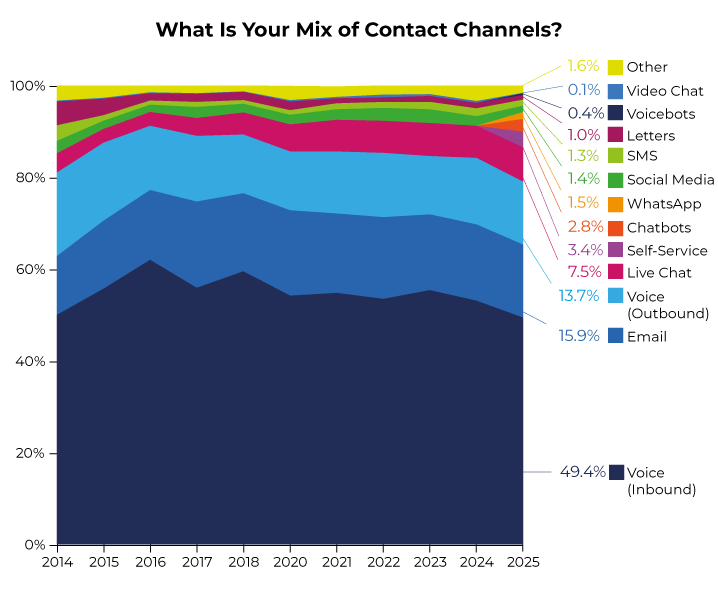
Voice is still a dominant channel in contact centres – according to our 2025 Research Report: What Contact Centres Are Doing Right Now:
Efficiency metrics often push contact centres to rotate agents across all channels – voice, email, and chat – without considering personal strengths or preferences.
Yet assigning agents to their preferred channels can significantly improve customer experience and employee satisfaction.
Quite simply, if somebody really enjoys calls, then why not consider making that a priority for them?
This approach can allow agents to develop mastery and confidence in their strongest channel, whilst customers, in turn, benefit from talking to someone who is engaged, competent, and genuinely invested in providing excellent service.
Beyond individual preference, you could also consider strategic allocation based on interaction type. For instance, complex or emotionally charged calls could be prioritized for agents who excel in voice, while simpler queries might be routed to chat or email – all to help ensure optimal outcomes for customers.
For expert advice on how to set the stage for cross-channel harmony, read our article: Ways to Reduce Friction Between Agents Working on Different Channels
AI has transformed customer support, yet many believe a lot of its value lies in augmentation – not replacement.

“AI is not just about improving self-service!
It’s about feeding agents the right information at the right time, so they don’t have to memorize everything, but can still communicate what customers need to hear using the empathy and soft skills required.” – Shep Hyken, Chief Amazement Officer (CAO) at Shepard Presentations LLC
This is a powerful combination, allowing agents to focus on emotional connection and problem-solving skills – rather than completing a daily memory test!
For example, AI can support agents with real-time prompts that suggest next steps or solutions, and personalized data insights (such as previous orders, buying patterns, or prior interactions), as well as language and accent matching to improve clarity and connection.
Improving your voice channel starts before agents even pick up the phone!
If you can’t show respect for the customer’s time, you’re essentially saying, “I don’t care about you” and ultimately getting every conversation off to a poor start.
So don’t leave your customers stuck in an hour-long loop of “Your call is very important to us”!
Instead, add in clear hold time announcements to manage expectations, callback options so customers can choose a convenient time to talk (rather than waiting on hold), and efficient routing to connect them quickly with the right agent when they do reach the front of the queue!
It can make all the difference! After all, respecting time doesn’t just improve the service experience, it signals that the organization values and prioritizes its customers, reinforcing trust and loyalty.
The voice channel remains a vital bridge between customers and agents, especially when addressing complex, emotional, or urgent needs.
So don’t neglect it! As these examples show, even small, thoughtful changes can help transform the voice experience for both customers and agents, ensuring that the channel continues to thrive – even in a world dominated by digital interactions.
Click here to join our Readers Panel to share your experiences and feature in future Call Centre Helper articles.
With thanks to the following people for sharing their thoughts for this article:
If you are looking for more information to improve your contract centre voice channels and deliver effective CX, read these articles next:

Megan Jones, Editor, Call Centre Helper
Megan interviews inspiring people across the contact centre industry to capture these amazing voices and turn them into best practice articles – covering all elements of what it takes to deliver truly outstanding employee and customer experiences.
Connect with Megan on LinkedIn
Read more by Megan JonesReviewed by: Xander Freeman

The Latest Customer Contact Research, Reports and White Papers straight to your inbox!
Get the latest insights from Call Centre Helper by signing up for our email content.
Close


13th October 2026
14th October 2026


