The Largest Online Community for Contact Centre Professionals


The Largest Online Community for Contact Centre Professionals
 Close



Published On: 27th Nov 2026 14:00
With so much conversation data now available to contact centres, how do you decide where to focus your efforts? Derek Corcoran at Scorebuddy shares five practical lessons from CCW Amsterdam on turning conversation data into CX improvements.
Walking around the show floor at CCW Amsterdam, there was no shortage of technology promising to improve different aspects of CX. From faster QA workflows to smarter bots and more detailed sentiment analysis, there was plenty on offer.
However, an interesting theme emerged from Scorebuddy’s conversations with contact centre leaders. Most already had plenty of tools (perhaps even too many in some cases!).
What they wanted was a reliable view of their customer conversations so they could work out where improvements were needed, based on their own data.
That’s essentially what CX intelligence is all about. By scoring as many conversations as possible, contact centres can identify which areas of their customer experience need attention and use those insights to decide what to do next.
Here are five key takeaways from CCW Amsterdam, along with some practical advice on putting them into action.
Walk around any contact centre exhibition and there will be a solution for almost every part of the customer journey, whether that’s reducing handle times, improving compliance or increasing self-service containment.
The difficulties start when contact centres invest in several of these tools and try to bring everything together. Each has its own dashboard and its own set of data, making it difficult to see what’s happening across the entire customer journey.
Before investing in more technology, it’s worth taking a closer look at what customer conversations are already revealing.
What to do: Contact centres should start by looking at the information they already have. Complaint logs, repeat contact rates, CSAT comments and QA results can all help identify where improvements are needed.
Even when working with a relatively small sample, this provides a starting point. Contact centre leaders can then assess whether their existing technology can help address the issue before investing in anything new.
For years, one of the biggest challenges in QA has been finding the time and resources to review enough interactions.
A typical manual QA programme reviews just 2–3% of contact centre interactions, leaving a lot of potentially useful information undiscovered.
Automated QA is changing that. With AI capable of assessing up to 100% of conversations, contact centres now face a different question: what should they do with all that additional information?
Greater coverage can help uncover patterns and recurring issues that previously went unnoticed simply because nobody had time to review those conversations.
What to do: Give QA coverage a purpose by linking it to a specific business outcome.
If the data points towards compliance issues, contact centres can develop scorecards that help identify conversations where there may be a risk. If repeat contacts are a concern, the focus should be on understanding why customers are getting back in touch.
Otherwise, teams could find themselves spending even more time working through reports without knowing where to start.
One concern that came up repeatedly during conversations at CCW Amsterdam was trust. AI can score thousands of conversations, but how can contact centres be confident that it’s assessing them in the same way as their best human evaluators?
If supervisors don’t trust the scores and agents regularly dispute them, it’s going to be difficult to get people on board.
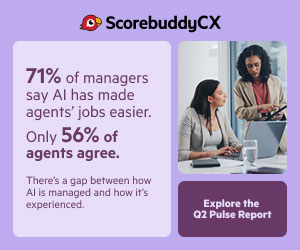
Scorebuddy’s AI Reality Check report highlights this difference in opinion:
Building trust takes time, and calibration and human oversight are an important part of that process.
Regular calibration sessions can help teams identify discrepancies between human and AI evaluations, while human oversight can be used to review conversations that require additional judgement.
What to do: Before rolling out AI scoring across the contact centre, teams should ask their evaluators and AI to score the same set of conversations.
They can then look at where the results differ, understand why and make adjustments, repeating the process until they’re confident that the scores accurately reflect their quality standards.
Identifying a recurring issue in customer conversations is a useful starting point, but what happens next?
The contact centre leaders getting the most out of QA were those sharing their findings with the people who could do something about them. That might mean coaching an agent, asking operations to investigate a recurring issue or sharing customer feedback with a product team.
However, Scorebuddy’s AI Reality Check report suggests there’s still some work to be done.
Among contact centres generating AI insights, just 18% of coaching conversations are triggered by those insights on average, while 15% don’t use them to trigger coaching at all.
Part of the problem is that scoring, analytics and coaching often sit in separate systems. By the time a finding makes its way to a team leader, several weeks may have passed.
Establishing a clear process for sharing QA findings with team leaders can help ensure that an issue identified on Monday is addressed in a coaching session that same week.
For example, a US commercial insurer working with BPO partners was struggling to get a consistent view of agent performance across its outsourced operations.
According to a Scorebuddy customer example, bringing its QA data together helped the insurer uncover more than 4,000 critical fails in six months that would otherwise have remained hidden within individual BPO reports.
Each represented a specific conversation that could be used to inform agent coaching.
What to do: Contact centre leaders can pick a recurring issue from the previous month’s QA results and look at what happened afterwards. Who received coaching? What changed? And how was the effectiveness of that coaching measured?
If those questions are difficult to answer, there’s a good opportunity to improve the process.
As more contact centres introduce chatbots and AI agents, it’s worth looking at how quality is measured across automated and human interactions.
In many contact centres, human agents are assessed against detailed QA scorecards, while bots are measured primarily on containment or deflection.
But from the customer’s perspective, it’s all part of the same experience. They still want their issue resolved, regardless of who or what they’re speaking to.
Bots may also be resolving fewer enquiries independently than expected. According to respondents to Scorebuddy’s AI Reality Check report, AI chat and voice bots fully resolve just 19% of customer queries on average, without human involvement at any stage.
Applying consistent quality standards across human and automated interactions can help contact centres better understand how effectively customers are being served, while identifying where improvements are needed.
What to do: Teams can take 10 bot conversations and 10 human agent conversations about the same topic and assess them against the same quality standards.
Looking at how effectively each resolves the customer’s issue could uncover opportunities for improvement that existing containment figures aren’t revealing.
Once contact centres have greater visibility of their conversations, they’ll probably find several areas that could benefit from improvement.
Perhaps customers are repeatedly contacting them about the same issue, agents are struggling to support vulnerable customers, or gaps in compliance have been uncovered.
Contact centres can’t tackle everything at once, so when deciding where to focus, it’s worth considering the following:
Contact centre leaders should start with an issue that meets all three criteria. Once an improvement has been made, they can return to their conversation data to measure the results and identify their next priority.
Having that broader view of conversations means contact centres can adapt their priorities as new issues emerge.
There was plenty of discussion at CCW Amsterdam about the different ways technology can improve CX. However, one of the most interesting takeaways was how much contact centres could learn from the data they already have.
Before investing in another tool or launching another improvement initiative, contact centre leaders should take a closer look at what their customers are telling them.
They might find that the area of CX they’ve been prioritising isn’t the one that needs the most attention after all.
This post has been re-published by kind permission of ScorebuddyCX - view the original article.

ScorebuddyCX connects the intelligence in customer conversations to the people who can act on it. AI QA and conversation analytics find what's happening, business intelligence shares it beyond the contact center, and coaching and learning close the loop.
Find out more about ScorebuddyCXReviewed by: Jo Robinson

The Latest Customer Contact Research, Reports and White Papers straight to your inbox!
Get the latest insights from Call Centre Helper by signing up for our email content.
Close


3rd December 2026