The Largest Online Community for Contact Centre Professionals


The Largest Online Community for Contact Centre Professionals
 Close
Close


Published On: 10th Sep 2026 09:30 - Modified: 14th Sep 2026
This blog summarises the key points from a recent article by Derek Corcoran at Scorebuddy, exploring how contact centres are shifting from traditional QA towards broader CX intelligence, and the challenges involved.
Most quality programmes were built around one fundamental question: Did the agent handle that conversation properly?
It’s a simplified view of QA, but for years, this was the main question contact centres needed help answering.
Today, that focus is starting to broaden.
The conversation is increasingly about what customers are saying, what those conversations reveal about the business, and what should happen as a result.
The shift from traditional QA towards CX intelligence matters because it changes both the purpose of quality programmes and the teams that can benefit from them.
It’s also a transition that comes with some practical challenges. Our research highlights why, and it’s worth looking at the evidence before assuming the industry has already figured it out.
Customer expectations have risen, while interaction volumes have followed.
The bigger change has been how businesses view those interactions. As AI has become more widely used in quality assurance, organisations have increasingly recognised that customer conversations contain some of their most direct feedback. Yet historically, very little of that information was being captured and put to wider use.
Quality teams encountered this limitation first-hand. There is only so many calls a person can listen to in a week. If an agent has two or three interactions reviewed each month, the vast majority remain untouched.
That made coverage a natural starting point for improvement.
According to the first edition of our Quarterly QA & CX Intelligence Pulse, 74% of contact centres had increased their QA coverage in the previous three months, with 27% reporting a significant increase.
AI has made much broader coverage possible, but increasing the number of interactions reviewed is only part of the story.
It’s easy to frame AI in QA as a simple progression: switch it on, reach 100% coverage and move on to the next challenge.
In practice, there’s more to it.
AI Auto Scoring can evaluate up to 100% of conversations across channels including voice, chat and email. Coverage at that scale would have been difficult for most quality teams to achieve manually just a few years ago.
But generating a score and having confidence in that score are two different things.
Reliable AI-assisted evaluation requires configuration, calibration, documentation and clear standards around what constitutes a good assessment. Without appropriate governance, it becomes difficult to know which outputs should influence decisions and which require further scrutiny.
The second edition of the Pulse looks at this issue directly. Among contact centres using AI to evaluate interactions, only 14% say those scores are always reviewed or challenged by a human.
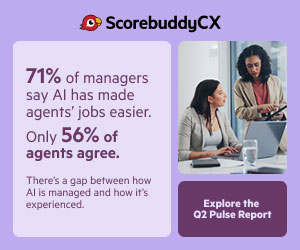
There is also a clear difference in confidence between groups. 38% of agents say they don’t trust AI-generated QA scores, compared with 19% of managers.
That gap matters. Greater coverage only creates value when the resulting information is trusted enough to influence action.
Reviewing more interactions produces a larger volume of information. But the real opportunity comes from deciding where that information should go next.
Customers reveal far more during conversations than whether an individual interaction met a QA standard. They explain why they contacted the business, where they became confused, what they struggled to find and sometimes what might persuade them to leave.
Those insights may originate in the contact centre, but they can be relevant far beyond it.
Product teams, for example, could identify recurring problems with features or processes by analysing hundreds of conversations rather than relying solely on tickets or assumptions. Marketing teams can see the language customers actually use. Operations and risk teams can identify recurring contact drivers, process failures and potential areas of exposure.
Diagram showing customer conversations scored and analysed inside the contact centre, with a dashed line marking where most organisations stop, and arrows carrying the insight past it to product, marketing, operations, and risk and compliance.
When conversation data is analysed effectively, it provides a much broader view of what customers are actually experiencing. That is the foundation of conversation analytics: not simply scoring interactions, but turning what customers say into information that other parts of the business can use.
This is also why reporting is so important. Scoring identifies what is happening; business intelligence helps connect those findings to the people who can respond.
If CX intelligence is a new concept, we’ve also explored separately what conversation intelligence is and who it is designed to support.
For quality teams, the move towards CX intelligence might initially sound as though QA is being replaced by something bigger.
In reality, QA remains at the centre of the process.
The quality of any insight depends on the quality of the underlying evaluation. Conversations need to be assessed consistently against clear standards before organisations can confidently use those findings elsewhere in the business.
The difference is that the role of QA can extend beyond scoring individual interactions.
With broader coverage, teams have more evidence to identify recurring patterns, decide which issues need escalation and support calibration and governance. It also creates a clearer role for human judgement in deciding when an AI-generated assessment should be accepted and when it needs to be reviewed.
And coaching remains an important part of the equation. 85% of professionals surveyed in the first edition of the Pulse said coaching remains the most effective driver of measurable improvement.
With greater visibility across interactions, QA teams have more evidence to identify what needs coaching – and where those interventions could make the biggest difference.

ScorebuddyCX connects the intelligence in customer conversations to the people who can act on it. AI QA and conversation analytics find what's happening, business intelligence shares it beyond the contact center, and coaching and learning close the loop.
Find out more about ScorebuddyCXReviewed by: Megan Jones

The Latest Customer Contact Research, Reports and White Papers straight to your inbox!
Get the latest insights from Call Centre Helper by signing up for our email content.
Close


14th October 2026
22nd October 2026
Let Sales Win – What’s Really Happening On Your Floor – Webinar


